Choosing The Right Example
UK Civil Service Insights: Applications

In my last newsletter, I mentioned that the examples on your written application don’t need to be work-related. This also applies to interviews. However, choosing what to write is only half the battle. How you write about your example also makes a big difference. What do I mean?
Good example + poorly written = low score (1-3)
Poor example + well written = low score (1-3)
Good example + well written = passing score (4*-7)
For a reminder of the scoring system, refer to this newsletter.
*Please note, in some cases the recruiting manager may set the pass mark at 5.
This newsletter focuses on an example I used earlier this year which wasn’t work-related.
Context
What was the example?
It involved my voluntary work as a treasurer planning an event for March 2024. In this role, we didn't have a budget; therefore, breaking even was primarily dependent on ticket sales. Ticket sales covered venue hire and other overheads. I had to advise on pricing (and discounts), and then ensure that ticket forecasting was accurate based on the information provided by the rest of the team. Contractual commitments to the venue meant that over-forecasting demand would lead to paying 50% or 100% of the cost per place (depending on when cancellation occurred). In a nutshell: the aim was to avoid needing to subsidise any of the £20k+ costs. Thankfully this wasn’t the case!
How did the example score?
February 2024 - I applied for a G7 role that asked for Making Effective Decisions as the lead* Behaviour and it scored a 3. The other Behaviours they asked for weren’t scored and that’s because my answer for the lead Behaviour only scored 3.
March 2024 - I applied for an SEO role that asked for Making Effective Decisions (not the lead Behaviour this time). It scored a 4 (the lead Behaviour scored a 5). This is consistent with what I mentioned in this newsletter about scores changing depending on the level you’re applying for. A recruitment freeze meant this role was withdrawn after I had been interviewed so I didn’t find out the outcome.
June 2024 - I had an SEO interview wherein I used the example above. Behaviours weren’t requested on the application form so I’m unsure how they would have scored it. However, they did provide the feedback below on how I communicated the answered verbally. I made it to the reserve list for this role… a surprise given how challenging the interview was!
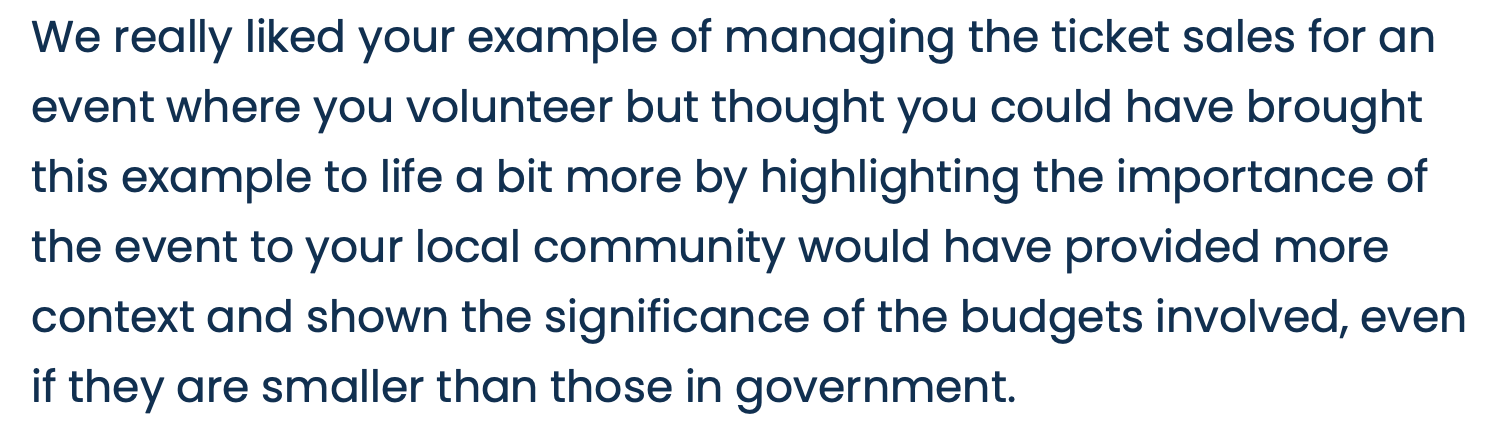
To note: I became an SEO in September 2022. This year, I was open to either a lateral move or a promotion providing the role gave me exposure to strategic finance as my experience until then was financial operations and management accounting. Maybe the SEO interviews shouldn’t have felt as nerve-racking as they were but perhaps it was because I was second-guessing the extent to which my existing finance experience was transferable. I’ll be covering career planning in a different newsletter so watch out for that.
*If a high volume of applications are received, the panel will most likely only sift the lead Behaviour (but that is optional so they could still decide to do a full sift).
Takeaways
1. Use your best example
The interview panel “really liked” the example despite the smaller ‘budget’ (refer to the above for the nuance). I chose the example because it demonstrated my ability to lead in making effective decisions. Whilst it would have been great to use an example from my day job (which has much larger figures), at the time, I felt this was the best example I had of leading the decisions rather than contributing/supporting.
2. Persevere
As noted above, I wanted a role in strategic finance. After applying for the G7 role, I could have taken the 3 to heart and assumed that perhaps I wasn’t cut out for a G7 strategic finance role. Instead, I was open to using the same answer for lateral moves. Doing so would have meant I got the experience to provide a different answer for a future G7 role. In the end I didn't have to wait too long since I was successful in gaining a temporary G7 promotion in August 2024 and now I’m getting the experience I was after whilst being a substantive SEO.
3. Think about your impact
The feedback they provided was really useful given that I wouldn’t have thought to include the community impact. Usually in my interview prep I try to incorporate feedback but I don’t think I did this time. In hindsight, I could have structured my answer differently. Verbal answers aren’t capped at 250 words like written applications so make sure you share everything that’s relevant! Using STARL is a great way to prompt you to include more in your answer:
S = Situation
T = Task
A = Action
R = Results
L = Learning
There are so many opportunities for you to progress your career in the Civil Service; use the examples that make your experience shine.
For all Civil Service jobs →https://www.civilservicejobs.service.gov.uk/csr/index.cgi
For finance Civil Service jobs → https://financecareers.civilservice.gov.uk
Suggestions for future newsletters → https://forms.office.com/r/brqp18VaCL
Do you have a suggestion for a future newsletter?
Respondent 1
Thank you sending the first response to the form (extract below)!
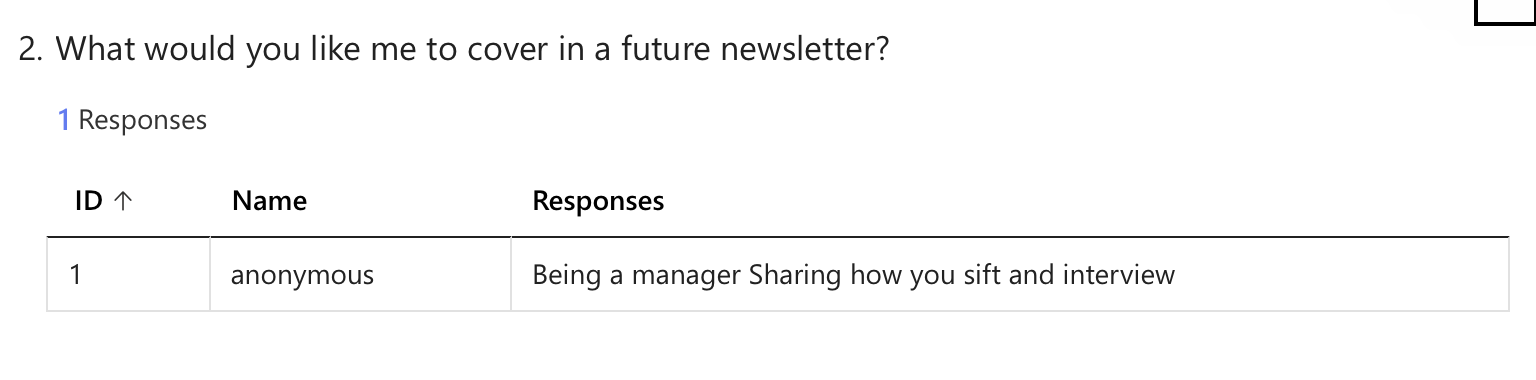
Unfortunately ‘being a manager’ provides insufficient detail for me to craft a newsletter. As the form is anonymous, I’m unable to follow up with you. Please resubmit with more details as it’d be great to see if I can work with your suggestion. Which aspects of being a manager are you referring to?
Regarding sifting and interviewing, on Q1 you indicated that you’re a current civil servant so please refer to the internal training on this via Civil Service Learning.
Everyone else
If you have something you’d like me to write about, send your suggestions! Please ensure your question/scenario is clear as the form is anonymous and if I incorporate your query into a future newsletter, I will need sufficient detail.